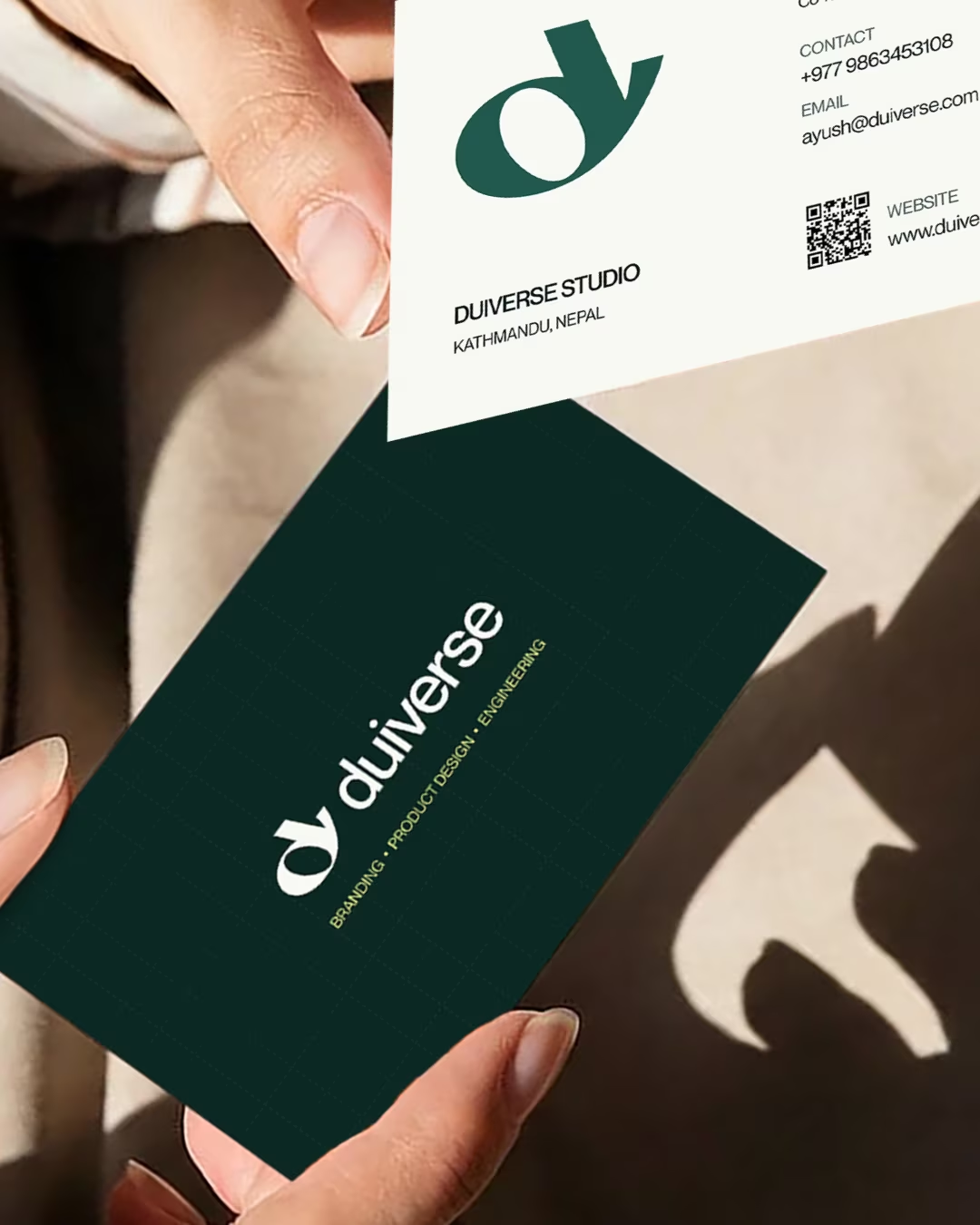


Beyond Design: What Duiverse Does for Growing Businesses


 Read with ChatGPT
 Read with Claude
 Read with AI Mode
What a branding agency actually does for an established, growing business rarely matches what founders expect going in. Most assume the deliverable is a new logo, a fresh website, or an updated color palette, something that changes how the business looks without changing anything underneath it. The work that actually moves a growing business happens beneath the visual layer: positioning, product clarity, and the systems that keep a brand consistent as the company scales past its founding team. Duiverse works beyond design because a business built on visual polish alone doesn't hold up once real growth starts testing it. Here's what we actually do, who we work with, and what the process looks like from the first call to launch.
- Design is the visible layer. Positioning and product clarity are what actually decide whether a brand works.
- Duiverse works across positioning, design, and development as one accountable team, not three separate vendors.
- Consistent brand presentation can increase revenue by up to 23 percent, per Lucidpress research.
- Engagements run as year-long partnerships so positioning holds through every later launch, not just the first one.
- Best fit: established businesses, 10-50 employees, $500K-$5M+ revenue, with a brand or website that undersells the business.
What Is Duiverse?
Duiverse is a dedicated brand and product team for established, non-technical businesses that don't want to hire one internally. We work with SaaS companies, fintech products, and premium service businesses that already have revenue and real customers, but whose brand, product, or website hasn't kept pace with the business operating underneath it. That gap shows up in specific ways: a product that converts worse than the underlying value should support, a website that undersells a company doing seven figures in revenue, or a brand that looks different depending on which vendor last touched it.
We're not a general agency bidding on every brief that comes through the door, and we're not a freelancer filling a single gap in the team. Most engagements run as year-long partnerships rather than one-off projects, because positioning and product clarity take longer than a single sprint to get right and even longer to hold in place.
What We Actually Do
The work spans three disciplines, and design is only the third one. Positioning comes first: who the business actually serves, what it offers that's different, and why someone chooses it over every other option they're looking at. This is strategy work, not visual work, and it's usually where the real problem was hiding the whole time.
Product and brand design come second. Once positioning is locked, we translate it into an identity system, a website, and a product experience that all say the same thing about the business. This is where most agencies start, which is exactly why so much branding work looks good and changes nothing: the design was never checked against a clear positioning decision, so it's guessing at what the business is instead of expressing it.
Development comes third, and it's the step that turns design into something real. Branding and positioning work covers the first discipline. Product and website design covers the second. Development and build covers the third. Positioning decides what gets built. Design decides how it's seen.
From Idea to Launch
Most engagements start with a discovery phase that has nothing to do with design tools. We map the business, the customer, and the competitive landscape before anyone opens Figma. That sounds slower than jumping straight to mockups, and it is, by about two weeks. It also means the identity and website work that follows doesn't get thrown out three months in because the underlying positioning was never actually agreed on.
Positioning gets locked next: a written, specific answer to who the business serves and why, checked against actual customers rather than assumed. Identity and product design come after that, built directly from the positioning instead of developed in parallel with it and reconciled later. Development closes the process, shipping the site or product instead of leaving it as a folder of files nobody on the client's team knows how to implement.
Who We Help
We work best with established businesses, usually 10 to 50 employees and $500K to $5M or more in annual revenue, that already have a product and paying customers but feel the brand or website is holding the business back rather than moving it forward. That includes SaaS companies whose product doesn't convert or retain the way the underlying metrics say it should. It includes fintech and other regulated products where trust has to be designed into the experience, not claimed in the copy. It includes premium service businesses that look smaller and less established than they actually are, because nothing about the brand signals the level they operate at.
We don't work well with early-stage startups still searching for product-market fit, since positioning work needs a real customer base to test against. We also don't work well with businesses looking for a single deliverable rather than an ongoing partner, since that's a different kind of engagement than the one we're built for.
Why Duiverse
The alternative to a dedicated team is usually a freelancer or a shifting collection of vendors, and both run into the same structural problem: the logo comes from one person, the website from another, and the brand ends up looking like three different companies depending on where a visitor encounters it.
Research by Lucidpress found that consistent brand presentation increases revenue by up to 23%, and the mechanism behind that number is straightforward. A business that looks and sounds the same everywhere is easier to trust and easier to remember than one that doesn't, and trust is what turns a visitor into a customer before a sales conversation even starts. Consistency isn't a design preference. It's the reason a stranger trusts you before you've said a word.
A dedicated team keeps that consistency by design, because one team holding the full context doesn't need to coordinate it across separate vendors who were each only ever handed part of the picture.
What Working With Us Looks Like
Engagements run as year-long partnerships, not fixed-scope projects, and that's deliberate. A positioning decision made in month one needs to hold through a website launch in month four and a product update in month nine, and that kind of continuity is hard to maintain across separate contracts with separate vendors who each start from scratch.
Most clients start with discovery and positioning, move into identity and design, then into development and launch, then stay on for ongoing design and product work as the business keeps changing around them. You get one team that already knows the business, the customers, and the decisions that were made and why, instead of re-briefing someone new every time something needs to change. A brand isn't finished at launch. It's maintained the same way the business is, one decision at a time.
Conclusion
Design is the part of the work anyone can see. It's rarely the part that was actually broken. Beyond design is where Duiverse spends most of its time, and it's why the businesses we work with end up with a brand that holds together instead of one that only looks good in the pitch deck.
If you're building, improving, or growing something and the brand hasn't caught up yet, talk to us at duiverse.com/contact before that gap starts costing you customers who were already sold.
Frequently Asked Questions
What does a branding agency actually do?
Is Duiverse a design agency or a branding agency?
How is Duiverse different from a freelancer?
What kind of businesses does Duiverse work with?
How long does a typical engagement take?
Why does positioning come before design?
Does Duiverse handle development, or just design?
You may want to read this too
A few posts that pair well with this one.

10/4/2026
7 Signs It's Time to Redesign Your Website (and 2 Signs It Isn't)
Knowing when to redesign your website is harder than it sounds, because most businesses decide based on how the site looks rather than what it does. A dated design is rarely the real reason to redesign. The real reasons are structural: the site breaks on phones, loads slowly, describes a business you no longer are, or needs a developer for every small change. This guide covers the seven signs that mean a redesign is genuinely due, the two signs that point to a different problem, and what to do before you approve a new site.When to Redesign Your Website: The Short AnswerRedesign your website when it stops doing its job, not when you get bored of it. Its job is to explain what you do, earn trust quickly, and move the right visitors toward contacting you. If the site fails at one of those because of how it is built or structured, a redesign is the right call. If it fails because the message underneath is unclear, a redesign will only give the same problem a newer look. The seven signs below are all structural, and each one comes with a quick test you can run this week.1. Your Website Doesn't Work Properly on MobileOpen your website on your phone and try to do the one thing a new visitor should do, such as booking a call or finding your services. If you have to pinch, zoom, or scroll sideways, the site was built for desktop and adapted later, or not at all. Most visitors now arrive on mobile, and Google primarily uses the mobile version of a site for indexing and ranking under its mobile-first indexing approach. That means a poor mobile experience costs you visitors and search visibility at the same time. Small fixes rarely solve this, because the layout itself was never designed for a small screen.2. Your Pages Load SlowlySpeed is the sign most owners underestimate, because their own browser has the site cached and it feels fast to them. Research published by Google found that as page load time goes from one second to three seconds, the probability of a visitor bouncing increases by 32%. The mechanism is simple: every second of waiting is a second where the visitor reconsiders whether your site is worth it. Run your homepage through Google PageSpeed Insights and look at the mobile score. If heavy themes, stacked plugins, and oversized images are the cause, a rebuild on a cleaner foundation fixes more than any amount of tuning.3. Your Business Has Changed but Your Website Hasn'tBusinesses change faster than their websites. You may have moved from small clients to larger ones, added a service, dropped one, or shifted from local customers to international ones. If your website still describes the business you were three years ago, it is attracting the clients you used to want. This is the clearest case for a redesign, because the pages, the navigation, and the proof on the site all need to reflect the new direction. Fix the positioning first, then design around it, which is the order we explain in what comes first: branding, design, or development.4. Your Team Avoids Sending People to the WebsiteListen to how your own team talks about the website. If salespeople send PDFs instead of links, apologize before sharing the site, or tell prospects to ignore it because "we're updating it," the site has become a liability. Your team talks to clients every day, so they notice the gap between what the business delivers and what the website promises before anyone else does. That gap costs deals quietly, because prospects check the site before they reply to a proposal. When your own people work around your website, the website is already losing you business.5. Every Small Update Needs a DeveloperA website should be something your team can update in minutes. If changing a headline, adding a case study, or publishing a blog post requires a ticket to a developer, updates stop happening. The site slowly fills with old offers, outdated team photos, and news from two years ago. Visitors read that as a business that is not paying attention. A redesign that moves you onto a proper content management system, with reusable page sections your team can edit, pays for itself in the updates that actually get made.6. Your Website Doesn't Match Your Brand AnymoreIf you have refreshed your logo, colors, or messaging but the website still carries the old ones, every visitor sees two versions of your business. One shows up on LinkedIn, in proposals, and on business cards. The other shows up on the site they check before replying. The Stanford Web Credibility Project found that 46.1% of people assessed a website's credibility partly on its visual design, including layout, typography, and color. Inconsistency reads as carelessness, even when the work behind it is excellent. A visual mismatch is a legitimate reason to redesign, as long as the brand direction is settled first.7. Visitors Can't Find What They Came ForWatch someone who has never seen your website try to answer three questions: what do you do, who is it for, and how do they get started. If they hesitate, click into the wrong page, or give up, your structure is the problem. Sites that grow page by page over the years end up with navigation that reflects internal history, not visitor needs. Services get buried under vague labels, and the contact path takes four clicks instead of one. Information architecture is a design problem, and it is one a redesign genuinely fixes.2 Signs a Redesign Won't Fix the ProblemSome symptoms look like design problems and are not. The first is traffic without enquiries on a site that already works on mobile and loads quickly. If people arrive, read, and leave, the issue is usually the message: visitors do not understand what you do or why it matters to them. We covered this in detail in why your website isn't bringing in clients. A new design wrapped around the same unclear message produces the same result.The second is wanting a redesign because a competitor launched a new site. Your competitor's redesign tells you nothing about whether yours is underperforming. Businesses that redesign for this reason usually end up with a site that looks current and performs exactly like the old one, a pattern we unpacked in your website redesign didn't increase leads. A redesign changes how your message looks. It cannot fix a message that was never clear.How Often Should You Redesign Your Website?There is no fixed schedule, but most business websites need a full redesign every three to five years. That range reflects how often devices, technology, and design conventions shift enough to make an older site feel dated or perform worse. Between redesigns, the site should improve continuously through new case studies, sharper copy, and page fixes based on what visitors actually do. A website that gets steady small improvements lasts longer and needs less dramatic redesigns. If you are redesigning every eighteen months, the problem is almost certainly the brief, not the website.What to Do Before You RedesignStart with an honest audit rather than a mood board. Pull your analytics and note which pages get traffic, where visitors drop off, and how many enquiries the site produces each month. Test the site on a phone and run a speed check. Then write down, in one sentence, who the website is for and what you want them to do. If you cannot write that sentence, the positioning needs work before any designer can help. If paid traffic is part of the plan, check what to fix on your website before you run ads as well.How Duiverse Approaches Website RedesignsDuiverse is a brand and digital team based in Nepal, working with established businesses in Nepal and abroad. We do not start a website redesign with visuals. We start by checking whether the positioning is clear, because a redesign built on an unclear message fails no matter how good it looks. Our Website Refresh partnership follows that order: audit, positioning check, structure, design, build, and a content system your team can update without a developer. We also tell businesses when they do not need a redesign at all, and when a smaller fix will do more.Redesign When the Website Is Holding the Business BackThe right time to redesign your website is when it holds the business back: breaking on phones, loading slowly, describing a business you have outgrown, or blocking your team from updating it. If none of the seven signs apply, keep the site and fix the message. A website redesign is not a fresh coat of paint. It is a decision about how your business shows up to everyone who checks before they call.If you are unsure which side of that line your site falls on, book a 30-minute call and we will tell you honestly whether you need a redesign, a smaller fix, or neither.
RReeaadd mmoorree
10/2/2026
Hiring a UI/UX Design Agency in Nepal? Read This Before You Sign.
Hiring a UI/UX design agency in Nepal looks simple from the outside. You search, shortlist a few studios with good-looking portfolios, compare quotes, and pick the one that feels right. The problem is that none of those steps tell you whether the agency can fix what is actually wrong with your product. This guide covers what a good agency should deliver, how to read a portfolio properly, the questions to ask before you sign, and the red flags that cost businesses the most money.What a UI/UX Design Agency in Nepal Should Actually DeliverUI is what users see: screens, colors, typography, and buttons. UX is how the product works: the flows, the order of steps, and whether people can finish what they came to do. A good agency handles both, and it starts with UX. Before any screen is designed, the team should understand who your users are, where they get stuck, and what the business needs the product to achieve. Visual design comes after those answers, not instead of them.By the end of an engagement you should own more than a folder of screens. Expect user flows that map every key journey, a design system with reusable components and clear rules, a clickable prototype that was tested before development, and handoff files your developers can build from without guessing. If a proposal lists only "UI design for 20 screens," you are buying decoration. Screens without flows and a system behind them start breaking the moment your developers add the next feature.Agency, Freelancer, or In-House Designer: Which Do You Need?Not every business needs an agency. If you have a clear brief, a product manager who can make decisions, and one specific screen to fix, a skilled freelancer can do excellent work for less. If you have steady product work and enough volume to keep someone busy full time, an in-house designer builds deep context over time. The trade-off is that one person rarely covers research, UX, UI, and brand at the same level. Most businesses discover this only after the first hire.An agency makes sense when the problem is bigger than one discipline, or when nobody on your side can direct design work with confidence. That second point matters most for non-technical founders. A freelancer will execute what you ask for. A good agency will tell you when what you are asking for is the wrong thing. We covered this difference in detail in why non-technical founders need a design partner, not a freelancer.How to Read a UI/UX PortfolioMost portfolios show final screens: polished mockups inside a phone frame against a soft gradient. That tells you the team can make things look good. It does not tell you whether the product worked better afterwards. Good-looking products fail all the time, a pattern we explored in why products that look good still fail to convert. What you want are case studies that show the problem, the reasoning, and what changed.When you review a case study, ask three things. What was broken before, in the client's own words? What did the agency decide, and why? What happened after launch? Not every client allows agencies to share hard numbers, so do not reject a studio only because metrics are missing. But if a case study never mentions a problem or a user, it is a gallery, not evidence of how the team thinks.10 Questions to Ask a UI/UX Agency Before You Sign1. Who will actually work on our project, and how much of their time do we get?2. What happens in the first two weeks?3. How do you do user research, and with which users?4. Will we test the design before development starts?5. What exactly do we receive at the end, and do we own every file?6. How do you hand off to our developers, and do you support them during the build?7. How many revision rounds are included, and what counts as a revision?8. What kind of project would you turn down?9. Can we speak to a past client directly?10. How will we know whether the work succeeded?The last three questions matter most. An agency that cannot connect you with a single past client is asking you to trust a portfolio and nothing else. An agency that has never turned down a project will say yes to anything, including your worst ideas. And an agency that cannot define success before the work starts will define it after, in whatever way makes the project look good.Red Flags That Cost Businesses the MostThe most expensive red flag is a quote sent before anyone asked about your users. If an agency can price your project after one email, it is pricing screens, not solving a problem. The second is a team that agrees with everything in the first meeting. Agreement feels good in a sales call and turns expensive three months later, when the product ships and nothing improves. The third is vague ownership: no named lead designer, no single point of contact, and no answer to who is responsible if the result misses.Watch the handoff too. Some agencies deliver Figma files and disappear, leaving developers to interpret spacing, states, and edge cases on their own. Every guess a developer makes moves the product further from the design you paid for. Ask to see a real handoff file from a past project. If it has no documented states for errors, loading, and empty screens, those gaps will become your team's problem.How UI/UX Agencies in Nepal Price Their WorkPricing varies more than most founders expect, because agencies are selling very different things under the same label. Some quote per screen. Some quote fixed-scope projects with defined phases. Others work on monthly retainers or longer partnerships where the same team stays with your product. Per-screen pricing is the easiest to compare and the worst predictor of results, because it rewards the agency for producing more screens rather than fewer, better ones.The factors that actually move the price are the number of user types, the complexity of the flows, whether research and testing are included, and whether a design system is part of the work. Ask every agency to break its quote into those parts. If one quote is half the price of the others, find out which part is missing. In most cases it is research or the design system, and those are exactly the two parts that stop a redesign from falling apart within a year.Research by McKinsey on the business value of design found that companies in the top quartile of its Design Index grew revenue 32 percentage points faster than their industry peers over five years. The mechanism is not visual polish. Those companies treated design as a continuous business function, with research, iteration, and leadership attention, rather than a one-off purchase made on price. That is the real difference you are comparing when quotes look far apart.What a Good First Month Looks LikeThe first month tells you more about an agency than any portfolio. A good team spends it understanding the business: interviewing you, talking to users where possible, auditing the current product, and agreeing on what success means before designing anything. You should see a clear problem statement and a plan by the end of week two. If you see high-fidelity screens in week one, the agency skipped the part that decides whether those screens will work.Your role in that month matters as much as theirs. The brief you give shapes every early decision, which is why how you brief a designer decides more than most founders realize. Share what has been tried, what failed, and what the numbers say, even when it is uncomfortable. If you want to see this inside a real engagement, we broke down what actually happens in the first 90 days with Duiverse.How Duiverse Approaches UI/UX WorkDuiverse is a brand and product design team based in Nepal, working with established businesses in Nepal and abroad. We start with positioning before we design a single screen, because a product that does not know who it is for cannot be designed well. With Jags Money, a fintech product, that meant restructuring the mobile experience and the wallet architecture so the app could grow without becoming harder to use. Our App Refresh partnership follows the same sequence for businesses with a live app: audit, direction, design system, redesign, and developer handoff. We work as a long-term partner rather than a one-off vendor, and we turn down projects where that is not the right fit.Choose the Agency That Asks Better QuestionsThe best UI/UX design agency in Nepal for your business is not the one with the prettiest portfolio or the lowest quote. It is the one that asks the hardest questions about your users before it talks about screens. Hire for thinking first, then judge the visuals. Good design is a decision process, and the screens are only where it becomes visible.If you are comparing agencies right now, book a 30-minute call and we will tell you honestly whether your product needs a redesign, a smaller fix, or something else first.
RReeaadd mmoorree
9/27/2026
Redesign or Rebuild Your App? Most Businesses Pick the Wrong One
Most apps that get rebuilt only needed a redesign.App redesign vs rebuild is one of the most expensive decisions an established business makes about its product, and most get it wrong in the same direction. The app feels dated, users drop off, and the team concludes that the whole thing needs to be thrown out and built again. In most cases the code is not the problem. The experience sitting on top of it is. This post shows you how to tell the difference, what each option actually involves, and which signs mean you genuinely need to start over.What Is the Difference Between an App Redesign and a Rebuild?A redesign changes what users see and how they move through the app. Screens, navigation, flows, visual design, copy, and the order in which things happen all get reworked. The backend, the database, and most of the business logic stay where they are. Your developers implement the new design on top of the system you already own, usually screen by screen. Users get a better app without your business carrying the risk of replacing working software.A rebuild replaces the code itself. The team writes a new app, often in a new framework, and migrates users and data across when it is ready. That means months where your developers are recreating features you already have instead of improving the ones users complain about. It also means rediscovering bugs the old system fixed years ago. A rebuild is a technical decision with a business cost, and it should only happen for technical reasons.Why Most Businesses Choose a Rebuild They Do Not NeedNon-technical owners usually experience their app as one thing. When it feels wrong, the whole thing feels wrong, and "start again" sounds like the clean answer. Developers sometimes reinforce this, because writing new code is more appealing than working inside old code someone else wrote. Neither side is being dishonest. But the complaint that started the conversation was almost always about the experience: users are confused, the app looks dated, and support gets the same questions every week.Joel Spolsky, co-founder of Stack Overflow, called rewriting code from scratch "the single worst strategic mistake that any software company can make." His example was Netscape, which spent roughly three years rewriting its browser while competitors took the market. The mechanism is simple. Old code looks messy because it contains years of fixes for real problems, and a rewrite throws those fixes away. You pay to get back to where you were before you can move forward.A rebuild resets your code. It does not reset the decisions that made the app confusing. If the same assumptions shape the new flows, you get a newer version of the same problem. The confusion lives in the structure of the experience, not in the programming language, and rewriting the language leaves that structure intact. This is why so many rebuilt apps launch late, cost more than planned, and still lose users at the same screens.Signs Your App Needs a RedesignThese patterns point to the experience, not the code:- Users download the app, open it a few times, then stop.- Support answers the same "how do I..." questions every week.- Screens look like they were designed by different people at different times.- New features made the app feel more cluttered, not more useful.- The app works, but it does not look like it belongs to a serious business.If most of these sound familiar, the problem sits in front of the code. Each feature added without a shared design system makes the app harder to understand, a pattern we covered in why adding more features is making your product worse. A redesign fixes this by deciding once how the app behaves and applying that decision to every screen. Your developers keep working in a codebase they already know. Users get an app that no longer needs explaining.Signs Your App Genuinely Needs a RebuildSome problems cannot be designed away. If the app crashes regularly, loads slowly on normal connections, or cannot handle your current number of users, the foundation is failing. If it runs on a framework that is no longer supported, security updates will eventually stop, and that is a real business risk. If every small change takes weeks because of how the system is structured, and more than one developer independently tells you the same thing, take it seriously. These are technical failures, and they need technical solutions.Even then, a rebuild should not be a straight copy of the old app. If you are going to replace the code, design the new experience first, test it, and build to that design. Otherwise you spend a rebuild budget and ship the same confusing flows on newer technology. The order matters: decide what the app should be, then decide what it should be built on. Rebuilding without redesigning is the most expensive way to stay in the same place.How to Decide: Four Questions to Ask Before You Spend the Budget1. Is the complaint about how the app feels, or how it performs? Confusion, clutter, and a dated look point to a redesign. Crashes, slowness, and security gaps point to a rebuild.2. Can your developers ship a new screen in days, not weeks? If yes, the codebase is healthy enough to redesign on top of.3. Where exactly do users drop off? If they leave at the same few screens, those screens are the problem, not the entire system.4. Would the same app on newer code solve the problem? If the honest answer is no, you need a redesign either way.Answer these honestly and the decision usually becomes obvious. Most established businesses find that three of the four point to a redesign. The reasons that point to a rebuild are specific and technical, and your developers should be able to explain them in plain language. If nobody on your side can judge those answers, that gap is worth closing first, which is what a product design partner does for non-technical teams. Old is not the same as broken.What an App Redesign Actually ChangesWhen we redesigned the Profnestor app, the backend stayed exactly the same. The flows, screens, and visual system were reworked from an audit of where users were getting stuck. Daily usage time went up 5% shortly after launch, with no new code underneath the experience. That is the point of a redesign: the product your users already rely on starts working the way they expect it to. It costs less than a rebuild, ships sooner, and targets the problem users actually complain about.A proper redesign starts with an audit, not with new visuals. Every screen gets mapped against what users are trying to do and where they stop. From that, the team builds a design system, redesigns each screen, prototypes the flows, and hands developers specs they can implement in stages. Good-looking screens alone do not fix retention, which is why products that look good still fail to convert. This is how our App Refresh partnership works for businesses with a live app and real users.Redesign When Users Struggle. Rebuild When the System Fails.Most apps that feel broken are not broken at all. They are hard to use, and that is a design problem with a design solution. Spend the rebuild budget only when the code itself is failing, and design the experience first either way.If you are not sure which one your app needs, the Product Direction Blueprint will tell you exactly what phase you're in and what should happen first.
RReeaadd mmoorree
